
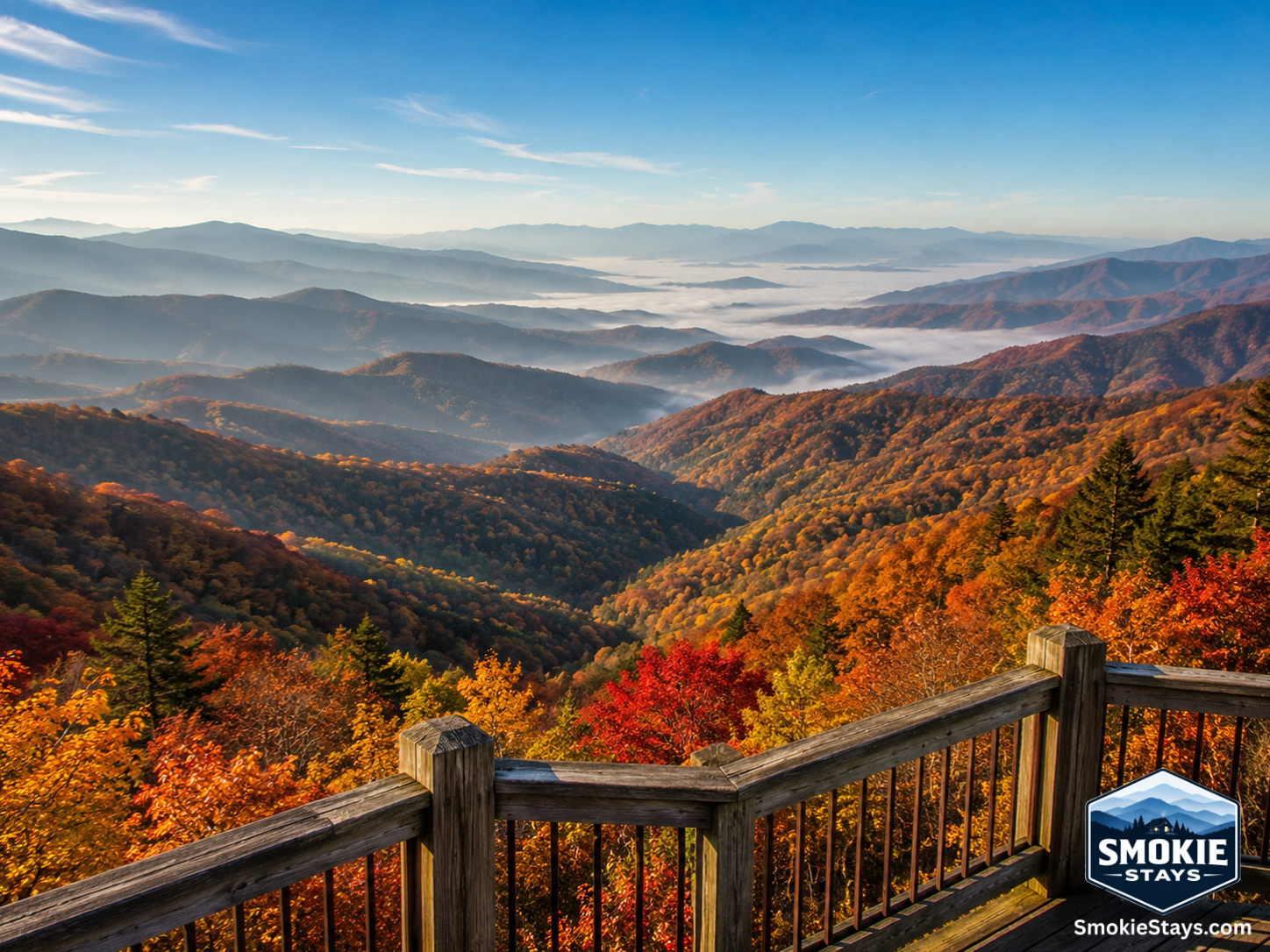
Fall in the Smoky Mountains doesn't arrive all at once. It moves — starting at the highest ridgelines in mid-September and slowly working its way down the mountainsides over the course of about seven weeks, until the lower elevations around Gatlinburg, Pigeon Forge, and Sevierville finally catch up in late October and early November. If you've ever wondered why people plan entire trips around "leaf season" in this part of Tennessee, this is why — there isn't one peak weekend, there's a whole moving window, and timing your visit right makes a real difference in what you see.
Here's how to think about it, and where to go once you're here.
How Fall Foliage Moves Through the Smokies
The mechanism is elevation. The Great Smoky Mountains span a huge range of elevations — from around 875 feet at the lowest points to over 6,600 feet at the highest peaks — and temperature drops with elevation. Cooler temperatures trigger the color change first, so the highest elevations turn weeks before the valley floors do.
Trees above 4,000 feet — areas like Kuwohi (formerly Clingmans Dome), Newfound Gap, and Chimney Tops — begin changing as early as mid-September, with species like yellow birch, American beech, and mountain maple leading the way. These high-elevation areas typically reach their peak color in early to mid-October.
From there, the color cascades downward. Mid-elevation areas, roughly 2,500 to 4,000 feet, tend to hit their peak in mid-to-late October, and this stretch is often considered the most spectacular of the whole season — a mix of sugar maples, scarlet oaks, and hickories producing the deep reds and oranges that fall foliage photos are built around.
Finally, the lower elevations — Cades Cove, Gatlinburg, Pigeon Forge, Sevierville, and the areas right around the park entrances — typically reach peak color in late October to early November. This is also when you'll see the most color directly from town, without needing to drive into the park at all.
The whole display can last seven weeks or more depending on the year's weather. A few practical notes on what affects timing: a wet late summer followed by cool, dry, sunny fall days tends to produce the most vibrant colors, while an unusually warm fall can delay and slightly mute the display. None of this is predictable months in advance with precision — but the elevation-based pattern itself is consistent every year, which is what makes planning around it workable.
The Best Scenic Drives for Fall Color
Newfound Gap Road (US-441) is the single most iconic fall drive in the park, and for good reason. This 33-mile route connects Gatlinburg to Cherokee, North Carolina, climbing to 5,046 feet at the gap itself and passing through multiple ecological zones along the way — meaning you'll see different stages of the color change depending on elevation as you drive. It's open year-round and offers numerous overlooks where you can pull over for photos. Morton Overlook, near the top, is a well-known spot for sunset views. Because it reaches such high elevation, Newfound Gap Road is the best choice for catching the earliest color in the season, typically from mid-September into early October.
Kuwohi Road (the access road to Kuwohi, formerly known as Clingmans Dome) branches off Newfound Gap Road and climbs to 6,643 feet — the highest point in the Smokies. A half-mile paved trail leads from the parking area to an observation tower with a 360-degree view. If you're visiting in the early part of foliage season and want to see color from the very top down, this is the spot.
Roaring Fork Motor Nature Trail is a 5.5-mile, one-way loop that starts just outside downtown Gatlinburg, making it one of the easiest scenic drives to access directly from a Gatlinburg cabin. It winds through dense old-growth forest, past mountain streams, historic log cabins, and trailheads — including access to Rainbow Falls. The drive itself takes about an hour without stopping, but plan for two to three hours if you want to explore the waterfalls and historic structures along the way. This route tends to peak in the mid-to-late October window, alongside the mid-elevation color change.
Cades Cove Loop Road is an 11-mile, one-way loop through an open valley surrounded by mountains on all sides — sometimes described as a natural amphitheater. It's the best of the scenic drives for wildlife viewing (black bears, deer, turkeys, and coyotes are regularly spotted in the open meadows) and also passes historic cabins, churches, and a working grist mill. Because Cades Cove sits at a lower elevation, it tends to hit peak color later in the season, typically late October into early November — making it a good choice if your trip falls toward the back end of foliage season. Note that Cades Cove Loop Road is closed to vehicles every Wednesday from May through September for Vehicle-Free Wednesdays, though this doesn't affect fall visits since the program ends September 30.
Foothills Parkway runs along a ridge outside the main park boundary and is built almost entirely around panoramic views — 33 miles of overlooks and pull-offs with some of the widest, most open views of the mountain range available from any road in the area. It's particularly good for sunrise or sunset, when the layered ridgelines catch the light in a way that's hard to replicate elsewhere.
Practical Planning Tips
Get a parking tag. Since 2023, Great Smoky Mountains National Park has required a parking tag for any vehicle parked for more than 15 minutes. Tags can be purchased online in advance or at entrance kiosks and visitor centers — getting one ahead of time saves a step once you're in the park.
Expect crowds, especially on weekends. Fall is one of the most popular times of year to visit the Smokies, and the most photogenic spots — Cades Cove, Newfound Gap, and the overlooks along Foothills Parkway — get busy on weekends throughout October. Arriving early in the morning, both for lighting and for crowd avoidance, is consistently good advice.
Watch for wildlife on the roads. Bears, deer, and turkeys regularly cross park roads, especially around dawn and dusk. Drive slowly, particularly on Cades Cove Loop Road and Roaring Fork.
Pack for variable conditions. Temperatures at higher elevations can be 10-20 degrees cooler than in the valley towns, and conditions can shift quickly. A layer you can add or remove makes a real difference if your day includes both a drive up to Newfound Gap and time spent in downtown Gatlinburg.
There's no entrance fee for the park itself, which makes scenic drives one of the most cost-effective things to do during a fall visit — the parking tag is the only requirement for stops longer than 15 minutes.
Timing Your Trip
If your priority is catching the earliest color — and avoiding the heaviest crowds — mid-to-late September into early October is your window, focused on Newfound Gap Road and Kuwohi.
If you want the classic, most vibrant display that most fall foliage photos are built around, mid-to-late October is generally considered the sweet spot for the park as a whole, with Roaring Fork and the Foothills Parkway at their best.
If your trip falls in late October or early November, Cades Cove and the lower-elevation areas around Gatlinburg, Pigeon Forge, and Sevierville will be at or near their peak — and you'll get color visible from town itself, not just from inside the park.
None of these windows are exact, and the only way to know for certain is to check conditions closer to your travel dates. But the elevation-based pattern means that almost any visit between mid-September and early November will put you somewhere in the foliage season — the question is mainly which elevation and which drives will be at their best during your specific dates.
Where to Stay for Fall Foliage Season
Fall is one of the most popular times of year to visit the Smokies, and cabins — especially those with porch or deck views facing the mountains — book up well in advance. A cabin with an elevated view means you may be able to watch the color change happen right from your own deck, in addition to the scenic drives.
We keep a small, hand-picked portfolio of cabins across the Sevierville, Pigeon Forge, and Gatlinburg area — take a look at what's available for fall stays at smokiestays.com/cabins.
Fall foliage timing varies year to year based on weather conditions and cannot be predicted with precision months in advance. For current color reports and conditions as your travel dates approach, check the Gatlinburg fall colors report at gatlinburg.com or the National Park Service site at nps.gov/grsm.