
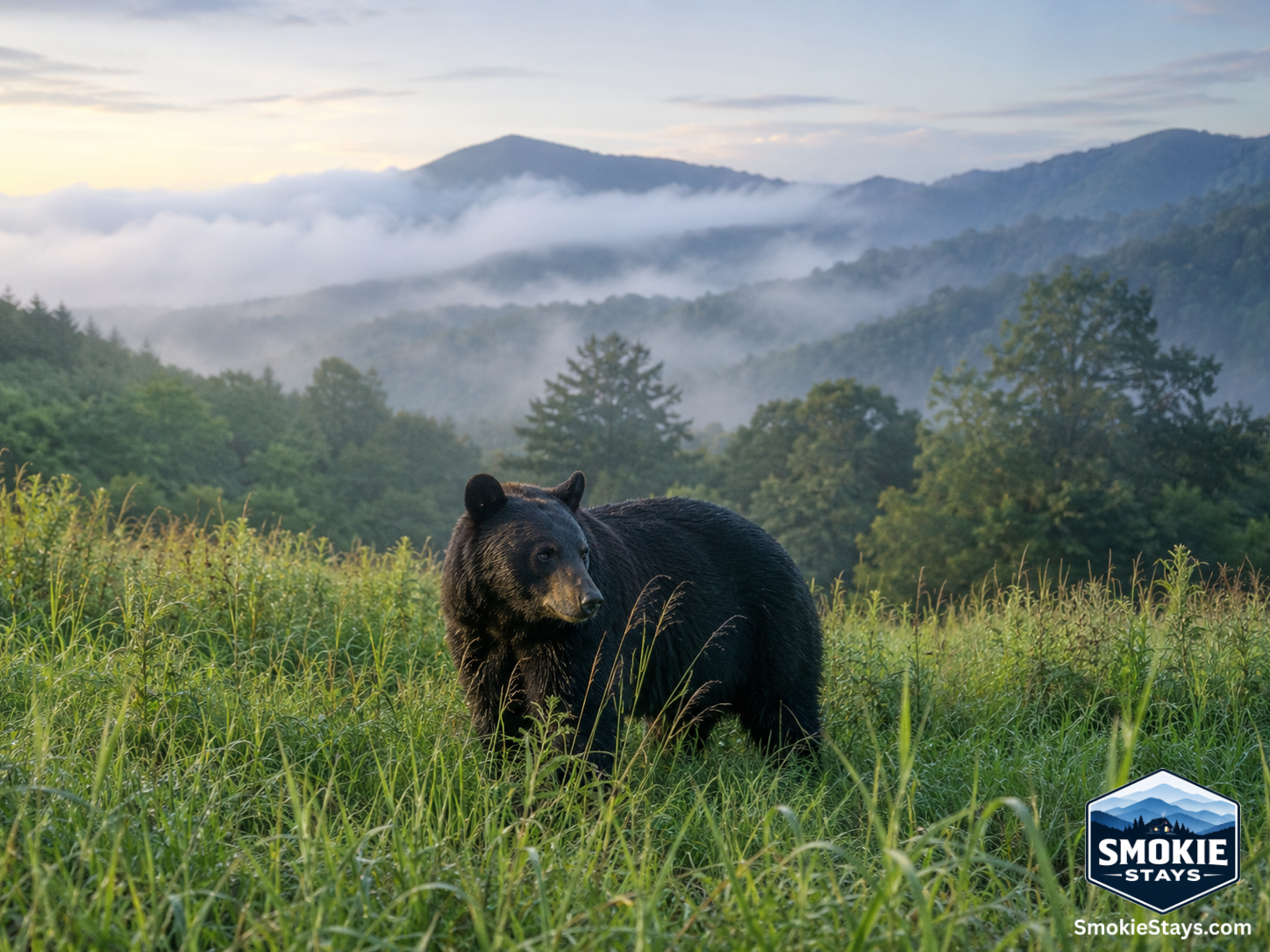
You will probably see a black bear in the Smoky Mountains. That's not a promise — wildlife doesn't operate on a visitor's schedule — but it's a realistic expectation for anyone spending more than a couple of days in Great Smoky Mountains National Park or the surrounding area. Approximately 1,900 bears live within the park's 522,000 acres, or about two bears per square mile — one of the densest black bear populations in the country. The population has roughly tripled since the early 1990s as habitat protections and food storage rules took effect. On the trails and scenic drives where visitors concentrate, bear sightings are common enough that the question isn't usually whether you'll see one — it's whether you'll know what to do when you do.
This guide covers everything you actually need: where bears are, when they're most active, how to watch them safely, what the law says, and how to handle an encounter if it becomes something more than a sighting from a distance.
Understanding Smoky Mountain Black Bears
Great Smoky Mountains National Park provides the largest protected bear habitat in the East. Black bears inhabit all elevations of the park. They are not grizzlies. The distinction matters practically: black bears are considerably less aggressive than grizzlies by default, and the protocol for dealing with an encounter is different — fight back rather than play dead, which is the opposite of grizzly advice.
Adults weigh anywhere from 100 to 600 pounds depending on sex, season, and food availability, and they can run 30 mph in short bursts and climb trees better than you can. A bear that looks slow and ambling in a meadow can cover ground remarkably fast when it decides to move. The comfortable distance between you and a bear is significantly larger than most people's instinct suggests.
Black bears in the Smokies are black in color — unlike black bears in other parts of the country, which can be brown or cinnamon. The cubs are often smaller than people expect: a three-month-old cub coming out of the den in spring can weigh less than five pounds and looks alarmingly approachable. That approachability is exactly what makes the cubs dangerous — their mother is nearby, she cannot see distance in the way humans can, and a person standing near her cubs triggers a protective response regardless of intent.
The Bear Calendar: When and Why They're Active
Bear behavior in the Smokies follows a seasonal pattern that's worth understanding before you visit.
Spring (March–May): Mother bears emerge from their dens with young cubs searching for limited early-season food sources. This is when bears are hungriest, when cubs are most visible, and when the most challenging encounters tend to happen. The bears are focused on eating and moving between food sources, and the combination of hungry bears and new cubs near trails produces the incidents that the National Park Service responds to most actively in spring.
Summer (June–August): Bears are active but more dispersed as vegetation matures across different elevations. Early morning and late evening sightings in open meadow areas are most common. The park's highest-traffic months coincide with active bear season, which is why summer produces the largest number of human-bear encounters by volume.
Fall (September–November): This is hyperphagia — the pre-hibernation eating period during which bears consume 20,000 calories or more per day to build fat reserves before denning. Fall hyperphagia from late September through early November produces the most overall bear activity. Bears are visible throughout the day rather than just at dawn and dusk, and they're focused almost exclusively on eating. Acorn mast years — when oak trees produce heavy crops — concentrate bears in specific areas and produce some of the most impressive wildlife viewing of the year.
Winter (December–February): Bears enter torpor rather than true hibernation — their body temperature drops slightly, but they can be roused and do occasionally emerge during warm spells. Cubs are born in January or February while the mother is in the den. Most visitor sightings are minimal during this window, though trail cameras at remote locations document continued movement throughout winter.
Where to See Bears: The Best Locations
Cades Cove, Roaring Fork Motor Nature Trail, Little River Road, and Newfound Gap Road are the best places to see bears in the Smoky Mountains.
Cades Cove is the single most productive bear-viewing location in the park. The 11-mile loop road passes through an open mountain valley with meadows, woodland edges, and the historic structures that attract the human visitors bears have learned to coexist with. Bears are seen in the open meadows regularly, particularly in the early morning and late afternoon hours. The combination of the open landscape and the slow-moving vehicle traffic on the loop road makes sightings here more sustained than most — you can watch a bear work a meadow for 20 or 30 minutes rather than catching a glimpse on a trail.
The Vehicle-Free Wednesdays program (May through September) removes cars from the loop and replaces them with cyclists and hikers. Walking the loop on a Vehicle-Free Wednesday puts you at ground level rather than behind a windshield — the bear encounters are more immediate and more memorable, though they require more careful attention to the safety protocols.
Roaring Fork Motor Nature Trail is a 5.5-mile one-way loop accessible from downtown Gatlinburg. The dense mixed forest and the succession of habitats along the route — old-growth, disturbed areas, stream corridors — attract bears reliably, particularly in spring and fall when they're moving between food sources. Sightings here are often closer to the road than in the open meadow of Cades Cove, which makes the 150-foot distance rule more practically important to observe.
Little River Road follows the Little Pigeon River from Sugarlands Visitor Center toward Townsend and passes through river corridor habitat that supports a high bear density year-round. Pull-offs along the road give you a vehicle-based viewing platform for bears crossing, fishing, or foraging along the river banks.
Newfound Gap Road at higher elevations is less predictable for bear sightings but produces some of the most dramatic encounters — bears in the subalpine forest zone behave differently than valley bears, and sightings at elevation in fall, when the berry crop concentrates activity, are worth specifically watching for.
Along park trails: The Alum Cave Trail, the Porters Creek Trail, and the trails in the Greenbrier area all pass through prime bear habitat. Backcountry encounters are more common on longer trails where human presence is sparser and bears are less habituated to crowds.
When to Go: Timing Your Viewing
Early morning — sunrise to 9 a.m. — and the two hours before sunset from April through October are peak bear activity times. These low-light, cooler periods match bear behavior patterns: they're most active when temperatures are manageable and human activity is lowest.
For Cades Cove specifically: the loop road opens at sunrise and closes at sunset. Arriving at the entrance at first light and driving the loop before the mid-morning crowd builds produces the best combination of bear activity and manageable vehicle traffic. On summer weekends, the lot near the loop entrance can fill before 8 a.m.
For trail-based sightings: starting a hike before 7 a.m. puts you on the trail during the most active bear window. Encounters on busy trails at midday are less common not because bears aren't there but because high human traffic tends to push them away from the immediate trail corridor.
The 150-Foot Rule: The Law and Its Reasoning
Willfully approaching a bear within 50 yards (150 feet), or any distance that disturbs or displaces a bear, is illegal in the park. Violation of this federal regulation can result in fines and arrest.
150 feet is further than it feels in practice. A bear in a meadow that looks like it's at a comfortable distance is often within that margin. The legal standard is behavioral rather than purely metric — if a bear changes its behavior because of your presence (stops eating, looks up, moves toward you or away from you), you're too close regardless of the actual distance.
Feeding wildlife is illegal and endangers you, other visitors, and bears. Feeding wildlife in the park is a federal offense and can result in fines of up to $5,000 or imprisonment for up to six months. The penalty exists because a fed bear is not just a safety problem for the visitor who fed it — it's a bear that has learned to associate humans with food, which makes it a threat to every subsequent visitor it encounters, and usually results in the bear being euthanized. "A fed bear is a dead bear" is the NPS phrase for a reason.
Bear Safety: What to Do
For the vast majority of encounters — bear in a meadow, bear crossing the road, bear visible from a pull-off — the protocol is simple: stay where you are, give the bear space, enjoy the sighting, and do not approach. The bear will continue doing what it was doing, which is typically eating or moving from one place to another.
The situations that require active protocol are:
A bear approaches you. Stay calm. Don't make sudden movements that could startle or disturb the bear. Make yourself look large. Back away slowly and quietly without running. Do not turn your back. Running triggers a chase response that the bear will win. Most approaches are investigative — the bear is curious and will typically stop, assess, and lose interest.
A bear bluff charges. Bears bluff charge — running toward a perceived threat and stopping short — as a communication behavior. Stand your ground. Most charges are bluffs. The bear is telling you it's uncomfortable, not committing to an attack. Stand your ground, make yourself large, and speak in a firm, calm voice.
An actual attack. If the bear shows no interest in your food and you are physically attacked, you are likely in danger of being its prey, so fight back aggressively with any available object. Do NOT play dead. This is the opposite of grizzly bear protocol. Black bears respond to resistance — fighting back aggressively is the correct response.
Bear spray: It is advised to carry bear spray in the Smoky Mountains, particularly in the backcountry. Bear spray is a concentrated capsaicin aerosol that creates a deterrent cloud when deployed — it is more effective than firearms in most encounter scenarios and is legal in the park. Know how to use it before your trip.
Report encounters and violations: If you see someone feeding or approaching a bear, or witness unnatural bear behavior, report it to park authorities immediately by calling 865-436-1230.
Food Storage: The Responsibility You Bring
Every food-related decision you make during your park visit affects the bears. Keep all food, trash, and scented items in a locked, hard-sided vehicle and lock vehicle doors. In backcountry areas, use bear cables to hang food.
The practical scope of "scented items" is broader than most visitors realize — it includes sunscreen, lip balm, toothpaste, energy bar wrappers, and the remnants of anything you ate in your car. Bears that have learned to associate human vehicles with food have a success rate high enough that the behavior becomes permanent. That bear will break into cars for the rest of its life, often requiring removal or euthanasia.
At camping areas, bear cables are provided and their use is mandatory for overnight food storage. At trailhead parking areas, any food left in your car should be in the trunk and out of sight — bears have broken through car windows and doors for visible food items.
Appalachian Bear Rescue: The Conservation Side
Appalachian Bear Rescue is located in Townsend, Tennessee. It takes in orphaned and injured young black bears and cares for them until they are healthy enough to be released back into the wild.
ABR is a non-profit operating under a federal permit, and it's the primary rehabilitation facility for bears orphaned when their mothers are killed by vehicles or other causes. The facility is not open to public tours — the whole point is minimizing bear-human contact so the animals can be successfully released — but it accepts donations and operates an active educational program. It's worth knowing about as the organization doing the conservation work that sustains the population visitors come to see.
Seeing Bears Without the Park: In-Town Encounters
Bears don't stop at the park boundary. Gatlinburg and the surrounding communities see regular bear activity, particularly in spring and fall when natural food sources are limited. A bear in a residential neighborhood or resort area is not necessarily a problem bear — it's a wild animal moving through its natural range, which happens to now include human-modified habitat. The same rules apply: don't approach, don't feed, secure your trash.
If you're staying in a cabin in the Smokies, particularly one surrounded by wooded terrain at the edges of the park, the possibility of a bear on or near the property is real. The correct response is to observe from inside the cabin or from the deck at a safe distance and enjoy the experience — it's one of the things that makes a mountain cabin stay fundamentally different from a hotel room. Trash cans should be secured when not in active use, and grills should be cleaned after cooking.
Experiencing Bears in a Controlled Setting
For visitors who want a guaranteed bear encounter without the wildlife uncertainty of the national park, two options provide the close interaction that's impossible to replicate at 150 feet:
Ober Mountain's Wildlife Encounter in Gatlinburg houses resident black bears in naturalistic habitat — bears that cannot be released into the wild due to injuries or human habituation. The habitat is designed around close observation, and the Black Bear & Berry Jam Festival in July adds keeper-led programming that provides educational context alongside the viewing.
Anakeesta's wildlife exhibits also feature resident bears as part of their mountaintop experience, alongside other native Smoky Mountain species.
Both provide educational programming and a closer view than the national park's 150-foot requirement allows — worth knowing about for families with young children for whom the frustration of a distant meadow sighting at dawn is a real logistical challenge.
Planning Your Bear-Watching Trip
The best bear-watching windows — spring for cubs, fall for hyperphagia activity — coincide with shoulder season in the Smokies, which means better cabin availability and more comfortable temperatures than peak summer. A cabin in the Gatlinburg area gives you proximity to the Roaring Fork Motor Nature Trail, Cades Cove access via Little River Road, and the early morning window at the most productive viewing locations before the crowds build.
We keep a small, hand-picked portfolio of cabins across the Sevierville, Pigeon Forge, and Gatlinburg area — take a look at what's available at smokiestays.com/cabins.
Black bear safety information in this article is provided by the National Park Service. For current bear activity reports, trail closures related to bear incidents, and the most current safety guidelines, visit nps.gov/grsm or call the park at (865) 436-1200. Report violations or unusual bear behavior at (865) 436-1230.