
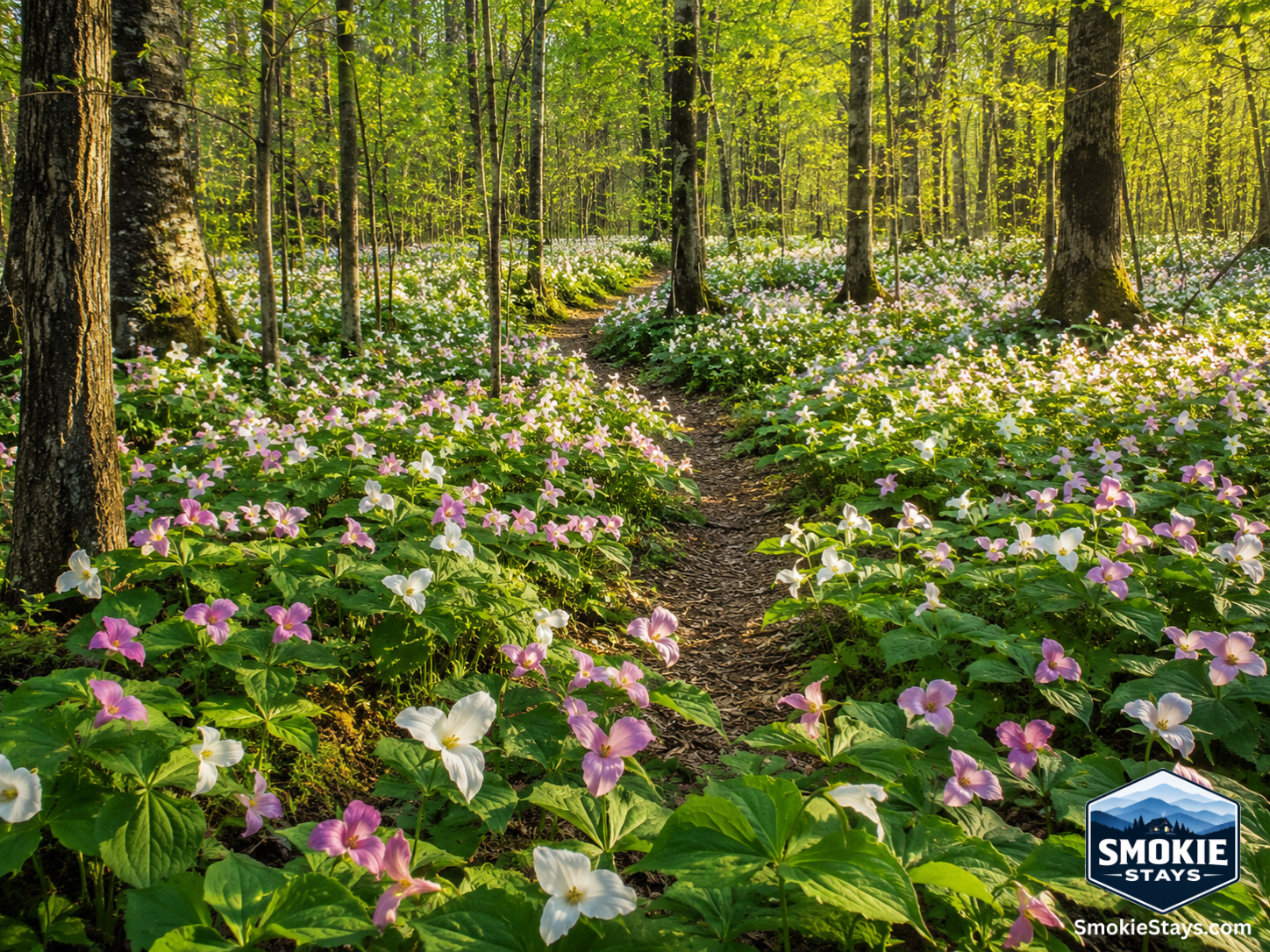
For four days every late April, something quietly extraordinary happens in Great Smoky Mountains National Park. The forest floor, still warming from winter, erupts in color — trilliums, trout lilies, bloodroot, fire pinks, and more than 1,500 wildflower species pushing up through the leaf litter before the canopy closes overhead and shades them back into dormancy. The window is short, the display is extraordinary, and for 76 years now, a small group of nature enthusiasts has been gathering in Gatlinburg to experience it with some of the most knowledgeable plant scientists, naturalists, and park historians in the region walking alongside them.
The Spring Wildflower Pilgrimage is not a festival in the conventional sense. There are no stages, no vendors, no crowds. There's a registration limit, a sold-out waitlist, and over 200 guided programs in four days. If that sounds more appealing than a standard spring vacation, this article was written for you.
What Is the Spring Wildflower Pilgrimage?
The Spring Wildflower Pilgrimage is a 68-year-old annual nonprofit event in Great Smoky Mountains National Park featuring professionally-guided walks to explore the region's rich natural and cultural resources. The 2026 edition — the 76th annual — ran April 22–25, making the 2027 edition the 77th, expected in late April based on the established pattern. Exact 2027 dates typically follow spring bloom conditions and are announced in early winter. Check the official event website at wildflowerpilgrimage.org for confirmed dates and registration opening as they're announced.
The four-day event consists of a variety of wildflower, fauna, and natural history walks, motorcades, photographic tours, art classes, and indoor seminars. Most programs are outdoors in Great Smoky Mountains National Park, while indoor offerings are held in various venues throughout Gatlinburg, TN.
Pilgrims from more than 40 states and several countries make the pilgrimage each year to learn about fungi, ferns, wildflowers, trees and shrubs, medicinal plants, insects, salamanders and snakes, birds, mammals, journaling, art, photography, and park history.
The Registration Reality: Act Fast
This is the most important practical detail in the entire article, and the one most people discover too late. Registration for the Wildflower Pilgrimage usually opens in February on the Wildflower website, and in recent years registration has sold out in the first weekend. Currently it remains highly sought after and filled by less than 1,000 participants — it's a rare reward of exceptional value.
That's not a typo. Fewer than 1,000 spots, selling out within days of opening. For a four-day event with over 200 programs in one of the most visited national parks in the country, the registration limit reflects a genuine commitment to keeping the group sizes small enough for the guided format to work — a botanist leading a wildflower walk can't meaningfully engage with 500 people at once.
If you're planning to attend the 2027 Pilgrimage, the move is to join the mailing list at wildflowerpilgrimage.org now, watch for the registration announcement in late January or February, and register immediately when it opens. Waiting a week is, in most recent years, waiting too long.
What the Smoky Mountains Wildflower Display Actually Looks Like
The ecological context helps explain why this particular park and this particular window draw so much attention. Great Smoky Mountains National Park exhibits a wildflower explosion in spring. This unique ecosystem, with abundant water and more than 100 species of trees, is also home to more than 1,500 species of wildflower. But these unique and colorful flowers only appear for a short time — as the ground is warmed by the springtime sun, and before the trees fully leaf out, which plunges the forest floor back into shade. This short window of just a few weeks produces a miraculous display of millions of vibrant flowers.
The elevation range of the park extends this window considerably compared to a flat landscape. Lower elevation species bloom first, in late March and early April — spring beauties, hepatica, and bloodroot appearing along valley trails while the higher ridges are still bare. By late April, when the Pilgrimage runs, the blooms are climbing the slopes and the variety on display across a single hike can span dozens of species at different stages of flower and growth.
Trilliums are the signature wildflower of the Smokies spring — large white and pink blooms that appear in dense drifts across the forest floor. The area around Porters Creek Trail in Greenbrier is considered one of the finest trillium displays in the entire park, drawing photographers every April regardless of the Pilgrimage. The Appalachian trail near Spence Field is known for its flame azalea displays in late spring. Chimney Tops trail (when open) passes through some of the most concentrated wildflower habitat at mid-elevation.
The Program Format: 200+ Sessions in Four Days
The week-long Wildflower Pilgrimage offers a variety of classes, guided hikes along scenic trails, evening programs, seminars, motorcades, and leisurely walks, all taking advantage of some of the best places and vantage points for viewing the magic of Great Smoky Mountains National Park. The programs offer a chance to enjoy the area up-close, and the benefit of visiting experts who share their unique knowledge and skills.
The program range is genuinely broad. The diverse programs include many on birding — a very popular aspect of the Pilgrimage — as well as ecology and earth science, edible flora, understanding salamanders and other native wildlife, and discovering the many trees, shrubs, wildflowers, ferns, and fungi that reside in the area. Programs for journaling and photography are also included.
Evening programs run after the outdoor sessions wrap up and tend toward the cultural and historical — storytelling performances, presentations on Cherokee plant knowledge, historical lectures about the communities that lived in the coves before the park was established. They're worth staying for, and they round out the day in a way that connects the natural history to the human history of the same landscape.
Some programs fill faster than others and are allocated on a first-come basis within the registration. Once you're registered for the event overall, checking the full program schedule early and selecting your preferred sessions before they fill is the recommended approach.
Who Leads the Programs
The guide quality is what separates the Wildflower Pilgrimage from simply walking a trail with a field guide. The naturalists, biologists, botanists, and park historians leading programs are working professionals in their fields — people who have spent years or decades studying specific aspects of the Smokies ecosystem and who bring genuine depth to what might otherwise be a pleasant but generalized nature walk.
A wildflower hike led by a botanist who specializes in trillium taxonomy is a fundamentally different experience from identifying trilliums in a field guide. An evening program on salamanders led by a herpetologist who has surveyed park streams for thirty years covers ground that no book or website has documented. That level of expertise, made accessible to a general audience in a beautiful outdoor setting, is what has sustained the Pilgrimage for over seven decades.
Experiencing the Wildflower Season Without the Pilgrimage
If you miss the registration window — which is likely if you're planning ahead without already being on the mailing list — late April in the Smokies is still worth visiting specifically for the wildflower display. The Pilgrimage uses the same trails the public has open access to; it's the guided expertise that's exclusive to registered participants, not the flowers themselves.
Several trails are considered reliable wildflower destinations during the late April window without requiring a guide:
Porters Creek Trail in Greenbrier — one of the most concentrated trillium displays in the park, along a gentle trail that follows an old homestead road through dense spring wildflower habitat. The 4-mile out-and-back is appropriate for most fitness levels.
Cove Hardwood Nature Trail near Chimney Tops — a short loop through old-growth forest with exceptional spring ephemeral diversity, including trilliums, trout lilies, and bloodroot.
Laurel Falls Trail — pending its reopening following the 2025 improvements, this popular paved trail through mixed forest passes reliable wildflower zones across its 2.6-mile round trip.
Little River Trail from Elkmont — a longer trail along the river that spans multiple plant communities and offers good diversity of both wildflowers and early spring birds in the riparian habitat.
The park's website at nps.gov/grsm posts seasonal wildflower bloom updates as April approaches — worth bookmarking if your trip planning is tied to catching specific species.
Practical Tips for Late April in the Smokies
Weather: Late April in the mountains runs the full spectrum — warm sunny days in the 60s, cold rainy days in the 40s, and occasional late-season cold fronts that drop temperatures unexpectedly. Layering is non-negotiable. A waterproof shell is worth packing even if the forecast looks clear, since conditions in the park can change within an hour.
Crowds: Late April is one of the quieter shoulder-season windows in the Smokies — busier than February but well before the Memorial Day surge. Trailhead parking at popular wildflower destinations fills by mid-morning on weekends. Arriving before 9 a.m. at locations like Porters Creek or Greenbrier gives you the best combination of solitude and morning light for photography.
Parking: A valid parking tag is required for any vehicle parked more than 15 minutes inside the national park. Purchase one in advance at recreation.gov or at entrance kiosks.
Photography: Late April morning light through a half-leafed forest canopy on a forest floor covered in trilliums is one of the best shooting situations in the region. A macro lens or close-focus capability matters for individual flower portraits; a wide-angle captures the drifts. Overcast days, counterintuitively, often produce better wildflower images than direct sun — the soft diffused light is more flattering to delicate flower petals than harsh midday shadows.
Planning Your Spring Stay
Late April sits in a shoulder-season window that offers some of the best value on the Smoky Mountains lodging calendar — better availability and rates than summer or fall, with spring bloom conditions that many repeat visitors consider the single best time of year to be in the park. A cabin with a porch and wooded surroundings captures the season in a way that a hotel room simply doesn't.
We keep a small, hand-picked portfolio of properties across the Sevierville, Pigeon Forge, and Gatlinburg area — take a look at what's available for spring stays at smokiestays.com/cabins.
The Spring Wildflower Pilgrimage 2027 exact dates and registration opening had not been announced at time of writing. Based on the established annual pattern, the event runs in late April and registration opens in late January or February — and sells out within days. Join the mailing list and check for updates at the official event website: wildflowerpilgrimage.org.