
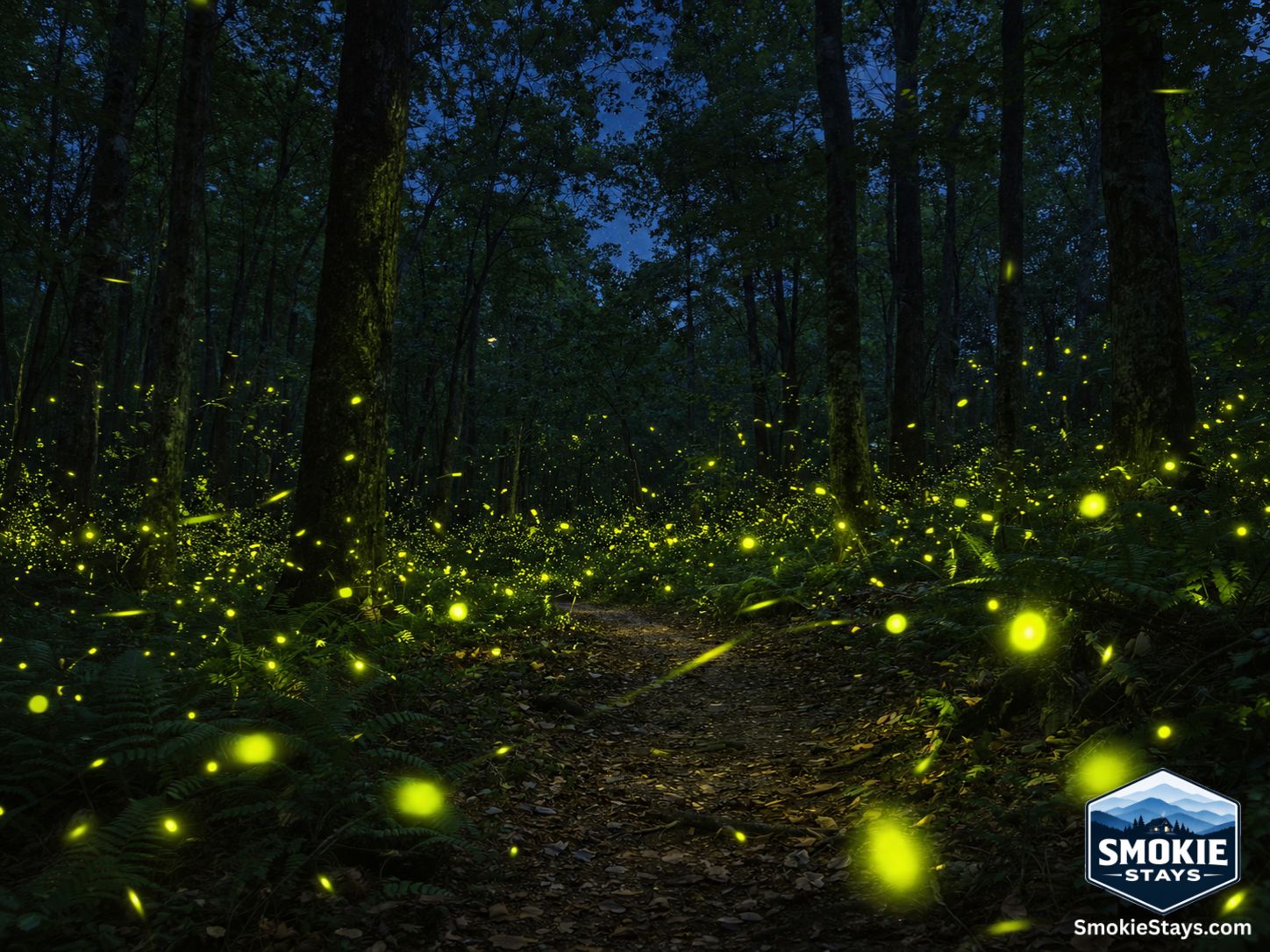
There are maybe a dozen places on Earth where fireflies synchronize. Where instead of the random, scattered blinking of a summer evening in a backyard, the entire forest — thousands of fireflies at once — flashes in coordinated waves, then goes completely dark, then flashes again. Pulse and silence. Pulse and silence. Over and over, for hours, in old-growth forest in the mountains of East Tennessee.
Great Smoky Mountains National Park is one of those places. And for eight nights every late May or early June, the National Park Service opens the Elkmont area of the park specifically for viewing it. There are 120 parking spots available per night. Roughly 960 total reservations for the entire event. And the odds of winning one through the lottery — the only way to access the event — are typically worse than 5%.
This is one of the rarest natural experiences in the United States. Here is everything you need to know to have a real chance of seeing it in 2027.
What Are Synchronous Fireflies?
Synchronous fireflies (Photinus carolinus) are one of at least 19 species of fireflies that live in Great Smoky Mountains National Park and one of only a few species in the world known to synchronize their flash patterns.
The synchronization is the thing that makes this specific. Common fireflies flash at random — beautiful in aggregate, but individually independent. Photinus carolinus flashes in coordinated patterns, with thousands of individuals in a population flashing simultaneously, going dark simultaneously, and repeating the sequence. The effect, seen from inside the forest where the population lives, is something most people describe as impossible to adequately photograph or describe — which is both true and why they keep trying.
This insect's reproductive display occurs for a couple of weeks every year throughout its range in the southern Appalachians, and is typically in late May or early June in the Elkmont area of the park. The synchronization serves a mating function — males flash to attract females in the leaf litter below — but the reason the species synchronizes rather than flashing randomly, like most others, is still not fully understood by scientists.
The Smokies population is one of the largest and most accessible synchronous firefly populations in the world. That combination of scale, accessibility, and protected habitat is what makes the annual event possible.
The Lottery: The Most Important Thing to Understand
The annual vehicle lottery on Recreation.gov typically opens in late April for viewing in late May–early June. For 2027, based on the established pattern — the 2026 lottery opened April 24, the 2025 lottery opened May 2 — expect the lottery window to open in late April 2027 and close approximately four days later.
Visitors can enter the lottery at recreation.gov for a $1 fee. Visitors may select two preferred viewing days when entering the lottery. The park will issue 120 reservations per night for a total of 960 for the event. Each reservation admits one vehicle with up to seven occupants.
Applicants will be notified by email by early May about their lottery status. Selected applicants will automatically receive a reservation, and a $29 reservation fee will be charged to the same card used for the application. This fee covers the reservation, portable restrooms, supplies and staffing. Reservations are non-refundable, non-transferable and valid only for the date issued. There is a limit of one lottery application per household per season.
The lottery typically opens in late April with eight managed viewing nights in late May–early June. Final dates will be released by the NPS on Recreation.gov, usually in April.
That last detail is the practical challenge: the NPS typically announces the viewing dates and lottery opening only a few weeks before the lottery opens. The window from announcement to lottery close is roughly one week. If you're not paying attention in April, you miss it.
The single most important action you can take right now: sign up for email alerts from Great Smoky Mountains National Park at nps.gov/grsm and create a Recreation.gov account at recreation.gov with your payment information already saved. When the lottery opens, you want to be able to enter in under two minutes. Timing within the lottery window doesn't affect your odds — all applications submitted before the deadline are treated equally — but missing the window entirely means missing the year.
What the Experience Is Actually Like
The managed event takes place at the Elkmont Historic District, one of the most atmospheric locations in the national park — a former resort community from the early 20th century, now preserved as a collection of historic cabins along Little River that give the forest floor an additional layer of history and character.
Access is restricted after noon during the viewing period to vehicles with reservations and registered campers in Elkmont Campground. Reservation holders park in the designated areas and walk the trails and roads through the firefly habitat after dark. Park staff are present throughout the evening to help visitors navigate to the best viewing areas and to protect the habitat from damage.
The display begins after full dark — typically around 9 to 10 p.m. depending on the time of year and cloud cover — and runs for several hours. The first flashes are tentative and scattered, and then, gradually, the synchronization builds. Experienced visitors describe it as a slow crescendo — the moment when the individual flashes resolve into coordinated waves is unmistakable, and once it happens the forest looks like something that has no good comparison in ordinary experience.
Red lights or red-filtered flashlights are required — white light disrupts the fireflies' behavior and ruins the experience for everyone nearby. The NPS provides guidance on this at the event, and rangers enforce it gently but consistently.
If You Don't Win the Lottery: Real Alternatives
The odds are worse than 5%. Most people who enter don't win. Here are the legitimate options for people who miss the lottery or discover the event too late.
Camp at Elkmont. Campers at Elkmont Campground often see fireflies from their sites — track Elkmont Campground now and get alerts when sites open to stay right in firefly habitat. Elkmont Campground reservations are made through Recreation.gov separately from the firefly lottery, and while the campground also books up quickly during the event window, it's a separate pool of access. Registered campers are permitted to walk to viewing areas during the event — making a campsite reservation an alternative path to the experience.
Visit adjacent areas. The synchronous firefly population extends beyond the managed event area. Other sections of the park — particularly along Little River Road and in the Cosby area — have populations that display during the same window, without the lottery requirement. The experience is less managed and typically less densely populated with fireflies, but it's real and it's free.
View from outside the restricted area. During the event, the roads outside the restricted zone remain accessible to any park visitor. Parking on Little River Road and walking toward Elkmont from outside the restricted boundary is a strategy some visitors use — you won't be in the primary viewing area, but you may see firefly activity in adjacent forest.
Try Cades Cove. Cades Cove has its own firefly population that begins displaying in early summer. The open meadow setting gives a different viewing geometry than the Elkmont forest — fireflies visible across the whole valley floor rather than within the forest canopy — and it requires no lottery. It's not the synchronous display, but it's a genuinely spectacular warm-weather evening in one of the most beautiful spots in the park.
What to Know on the Ground
Arrive before the noon access restriction. Reservation holders must be in the parking area before noon on their reserved date. Arriving after noon means being turned away regardless of your reservation.
Bring red lights. Small red flashlights or red cellophane over regular flashlights. Do not use white light in the viewing areas. Do not use flash photography. The park is explicit about this, and for good reason — white light causes the fireflies to stop flashing.
Dress for the mountain night. Late May evenings in the Elkmont area drop into the 50s after dark. A fleece or light jacket, long pants, and insect repellent make the experience considerably more comfortable.
Stay on the trails. The fireflies live in the leaf litter on the forest floor. Walking off-trail compacts the soil and destroys the habitat. The NPS manages this actively, and it's worth understanding why the rule exists — not just following it.
Be patient. The display doesn't peak immediately after dark. Arriving early, getting settled, letting your eyes adjust, and allowing the display to build over 30 to 45 minutes is the right approach. People who expect an instant spectacle sometimes leave before the best part starts.
Planning Around the Firefly Season
Late May and early June in the Smokies — the window when the firefly event runs — is one of the genuinely underrated times to visit the region. The summer crowds haven't fully arrived, the national park is at peak green, the wildflower season is transitioning to its later species, and temperatures are warm without the August heat.
If you're planning a trip specifically around the firefly lottery, the prudent approach is to keep your travel dates flexible until after lottery results are announced in early May — then book lodging for whichever night you were assigned. Trying to book lodging for a specific date before you know your lottery result and then entering the lottery hoping for that date is the common mistake that leads to expensive changes or missed opportunities.
We keep a small, hand-picked portfolio of cabins across the Sevierville, Pigeon Forge, and Gatlinburg area — the Gatlinburg corridor is the closest lodging to Elkmont, making it the most convenient base camp for the firefly event. Take a look at what's available at smokiestays.com/cabins.
Synchronous firefly viewing event dates and lottery details for 2027 are announced by the National Park Service, typically in April. The lottery opens and closes within a four-day window — set up a Recreation.gov account and NPS email alerts now to avoid missing it. For the most current information, visit nps.gov/grsm and recreation.gov.